Tuesday, November 23, 2010

Cape Town: Mega-Events - The bad


The 2010 FIFA World Cup was held in South Africa, necessitating the upgrade and construction of new stadiums across the country. Scenic though it is, Cape Town's Green Point stadium was both the most expensive to build, and will be the most expensive to manage, as well as hardest to book. Though Cape Town had two other stadiums that could have been upgraded, by account of City officials, FIFA strong-armed the City into building the Green Point stadium rather than using stadiums in poor, more dangerous and less scenic locales. Once the world cup was over and the haze of the party had worn off, the City found that the management company hired to book and run events and pay on-going operational and maintenance costs bailed out, leaving the City with a huge liability it couldn't afford and couldn't use because of its cost - what is known as a white elephant. Recent Olympics hosts have found themselves with the same problem - all hoping to recreate the "Barcelona Effect," they overspend their capital budgets only to find themselves with fond memories and a painful operational budget.

Cape Town: Service Delivery


As detailed in the last couple of posts, the constitutional mandate for housing has erupted into really difficult politics. Similarly, the politics of service delivery, based on a right to basic services like water, sewage, energy and waste removal have ignited rioting and anger toward government. As government intends grander investments in growing residential areas, there has been a major effort to provide these basic services in the meantime. Unequal, slow in coming, and often below expectations, these services have arrived, but people still feel angry. A Special Report in The Economist on South Africa last spring ended with an article that referenced Alexis de Tocqueville's quote from On Democracy, Revolution and Society, that "generally speaking, the most perilous moment for a bad government is one when it seeks to mend its ways....Patiently endured for so long as it seemed beyond redress, a grievance comes to appear intolerable once the possibility of removing it crosses men's minds." In other words, revolution comes not when nothing is expected, but when something promised is not delivered to expectation.

Saturday, November 20, 2010

Cape Town: The Politics of Free Housing (part II)

As the government has built homes, the politics of who gets homes, where and when have resulted in anger and even violence. The N2 gateway project, shown above, was built when settlers living in shacks on the edge of the black township of Langa, in an area called Joe Slovo, were removed in exchange for the promise of homes. When the homes were complete, those who had been displaced were told that the price of the homes would be far higher than promised - a price no shack-dwelling family could afford - and so they remained in the "temporary" settlement they had been removed to, 20 kilometers from friends and family, 20 kilometers further from potential jobs in Cape Town, and in the arid desert flats. When the remaining inhabitants of Joe Slovo protested by marching 30,000 people into the adjacent highway to stop traffic, they were repeatedly teargassed and shot with rubber bullets and their shacks were destroyed. But they stayed, and many court cases and 2 years later, the government has said these houses are for the people of Joe Slovo, but the bank who owns them, still gets to recoup its money - so there is a stalemate. People without adequate housing live around the edges of beautiful new homes they can't afford, but no one else is allowed, while the bank continues to lose money, and the government continues to lose credibility. How is this good for anyone?

Cape Town: The Politics of Free Housing (part I)


After Apartheid ended in 1994, people of all colors - previously restricted to only certain places where they were born, assigned or worked - were free to move about the country again. Many moved to the townships on the edges of cities from the arid "homelands" they had arbitrarily been assigned when removed from nicer areas over the preceding 50 years. The cities were where husbands were, job prospects existed, and where the government would presumably build the new homes that the poor were promised under the new constitution. Over 16 years, the national government has built over 2.6 million homes, but it is not nearly enough to account for all of the shacks that have spring up around cities. But tension rises with demand and expectations.

Cape Town: Working Waterfront

Cape Town's waterfront is extensive and is perhaps the City's foremost tourist destination, but what is really unique is how the working elements of the harbor, like the drydocks shown above, are seamlessly woven into the publicly accessible tourist areas. Three Leading Hotels of the World properties, at least three high-end shopping malls, and countless restaurants, souvenir shops, and tourist cruises are scattered throughout the Victoria & Alfred Waterfront. Sitting at restaurants you watch barges and cranes come and go. Walking the piers you see fishing boats coming in to drop their daily catch. From $500+ per night hotel rooms and multimillion dollar apartments you have a gorgeous view of the ocean or Table Mountain, with a boat repair facility in the foreground. And this isn't just cutesy remnants of olden days; rather, gritty industrial business is still thriving in the middle of this high value real estate. In most other waterfront cities around the world, new residential and commercial construction displaces the industrial trades to faraway edges or more blue collar towns, but in Cape Town, there is a very intentional mix that creates a really fascinating place to walk around day after day.

Friday, November 19, 2010

Cape Town: Ecosystem Services - Environmental Resources, Threat, Protection and Priorities

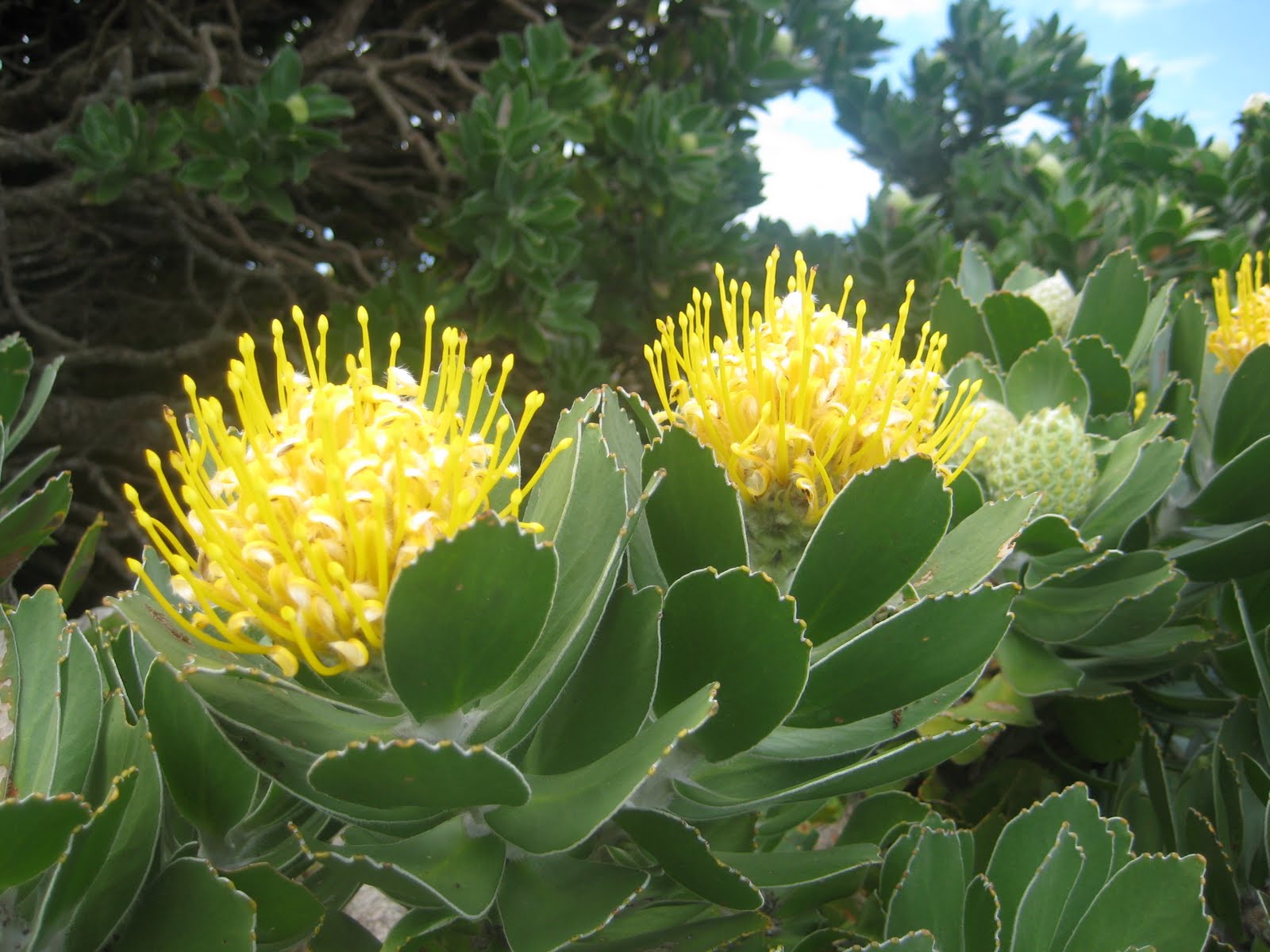
Cape Town and the surrounding Western Cape region are home to an endemic plant kingdom - that is to say, the entirety of one of the world's six plant kingdom is wholly contained within this region. The are boasts the richest plant species biodiversity, in species per unit area, in the world, with roughly four times more species per square kilometer than even the Brazilian rain forest according to a sign on Table Mountain. However, in a region with intense pressures of housing development (to provide adequate shelter for the millions without as a result of historic structural violence described previously) and limited resources, preserving rare plant species is a tough investment to prioritize. UNESCO has designated the Cape Floral Region a world heritage site to help. Local planners have turned to the ecosystem services approach to build justification and a rationalized prioritization system for saving species. The logic of ecosystem services is that the function of the ecosystem, not just its individual components, provides services of immeasurable value. Individual plants and even species may be lost so long as overall diversity, health and function are maintained. Still, its a tough trade-off, but would be an even tougher loss.

Cape Town: The Good and Bad of Natural Factors

Cape Town's city center is a crescent shaped waterfront that climbs the gentle slopes at the bottom of table mountain, which creates a natural bowl, protected on all sides with extensive waterfront. That's about as ideal a natural location for a city as it gets: the mountain provides protection and natural beauty, springs provide natural fresh water from the mountain, development is protected from high seas (and sea level rise, for the most part) by the slope up to the mountain, and the waterfront seems disproportionately extensive - a huge economic boon. So while natural factors can provide so much, they can also be used for ill, as they long were in Cape Town during South Africa's Apartheid era. From 1946 to 1994, insidious laws separated people by skin color for the purpose of economic and educational opportunity, and natural factors were used to segregate people physically. White people got to live in the city center, black and colored were relegated to the low-lying flats on the far side of the mountain where they were far from jobs and in flood-prone lands. The implications of this kind of segregation - for economic opportunity, education, access to jobs and services - are a truly evil kind of structural violence that was perpetrated on people for nearly 50 years, and has deeply-ingrained repercussions today.